Showing posts with label Meta. Show all posts

Sunday, October 31, 2021

Details about the Buick

Now that I have one of these guitars in my hands, let us explore some of the finer points that are relevant to guitar players.


First and foremost, the guitar is a solidbody, obviously. It's the standard 1.75" thick, and the body wood is Mahogany (quite possibly Honduran or some other tropical variety). Its neck is maple and rosewood. The body is a lot smaller than the photos make it look. It's actually quite compact.


I'm not usually a fan of gloss finish on necks (they tend to slow me down), but this one doesn't seem to have that effect. The headstock runs straight with the neck, unlike the slight tilt-back of later specimens. String trees hold the first four strings in place. Note the matte black washer on the 2nd string tuning machine. This points to either some sort of mod in its life or a jumbled assembly with spare parts.


Vintage Schaller tuning machines, labeled "Made in W. Germany". A Cold War relic! This was probably one of the most exciting things to find on this guitar.


From what I've been able to gather, the Motherbuckers were wound to a DC resistance of at least 4.3K-ohms per coil, which puts the three together at somewhere around 13K. This is fairly hot, especially for its time, though the sound it produces is still very clear and rich in harmonics--very little mud, if any. The output drops like a marble in the sink when coils are switched out of phase due to their proximity, though the sounds produced could still be usable in some context.


The neck screws are unplated brass, I can tell from the tarnishing. But is this neckplate brass or gold? Who knows? Just another finger pointing towards "thrown together"--it is a prototype after all. That control cavity plate is chrome. The wiring inside is kinda rat's nest looking, but, again, prototype.
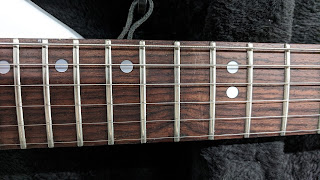


These frets still have plenty of life in them. The action is extremely low, which makes this guitar unbelievably easy to play.  The 5th-string-offset inlays were JBP's signature touch at the time.

All in all it's a fantastic instrument, built like a tank and unprecedentedly elegant. The perfect new wave guitar, which is what it was made for after all. The only complaint I really have is the fact that the single pickup doesn't give you the same timbral range you can get with a guitar with 2 or 3 pickups spaced from body to neck. But it's a detail I'm more than willing to overlook to focus on the fact that I have this thing at all. 11/10, would bust down the doors of some current guitar company and demand they put it back in production.


The Buick Prototype is Mine.

 The readership of this blog is near zero, I know, and that's okay. I still need some sort of place to consolidate all my thoughts through this hyperfixation of mine. That means I'm going to share some exciting news with all... three of you.

So, I've talked about Bob Mothersbaugh's Buick models being in the possession of author Jade Dellinger. But there was one detail I intentionally left out. Those two were not the only two he had. No... there was one more.


Yes, my friends, there was a white one in his collection as well. It was the prototype version, displayed at NAMM in 1982 and lying low for decades hence. I conveniently left out any mention of it because I wanted to keep a particular detail a secret. Mr. Dellinger was considering selling it and simply keeping Bob's.

Now, an opportunity like this presents itself at the very most once in a lifetime. I had a replica Mercury I was going to work on, but the chance to own a genuine USA-made J.B. Player was something I could not possibly pass up. Jade gave me a price. I accepted and got the money together. I was ready by the early October.

And on the 28th, it arrived.


I've gotta say, it's better than I could ever have dreamed. Dana Zacuto was a master. It sounds like new wave--the Motherbucker is powerful but still bright and harmonically rich, like a beefy, MSG-seasoned Strat. The neck, as Eric Lamb said, is supremely comfortable and fast-feeling. The action is incredibly low, on par with some Michael Kelly guitars I've played. This is truly a player's guitar. It's effortless. Easily my greatest treasure.

I'll get to specifics in the next post, but in the meantime I'd like to thank Jade Dellinger one more time. You've made my year.

I've been so enthused about owning this thing I made this:


Saturday, June 19, 2021

What I Know So Far

 J.B. Player was founded in 1981 by Dana Zacuto (d. 2004) in Los Angeles, CA. The company made custom electric guitars and basses with contemporary styling for the Los Angeles rock scene. This was the age of the superstrat and the pointy guitar, and J.B. Player delivered--from hot-rodded S-types to Explorers, and even a few B. C. Rich shapes to be found. Dana was the brother of Randy Zacuto, who founded the guitar parts company Mighty Mite. The latter company supplied parts for several other builders in the area, including Kramer and Charvel. Of all the makers that Mighty Mite supplied, it was perhaps J.B. Player that pushed the envelope furthest. As recalled by former associate Eric Lamb in a forum post:

"The owner at that time, Dana, was not only an incredibly crazy man, he was driven to try and make a great playing instrument for a fair price. Many of his guitars I still have were quite innovative... a strat with a built in wireless system in the guitar so you didn't need to have a transmitter on your belt... another one that he called 'The Buick', that had just one triple coil pickup that was wired to play any of the three coils independently, in or out of phase or all at the same time!"

While the built-in wireless system would take some time to be developed into a marketable product, the exotic Buick model was good to go from the start. In 1982, J.B. Player launched its "New Wave" line of electric guitars and basses. The Buick, whose body shape was appropriately radical and zany for the time, appeared in both guitar and bass form, and was accompanied by the Mercury, a model which was more conservative in comparison to its sibling, but striking and unmistakable nonetheless. The triple coil pickup--the legendary Mighty Mite Motherbucker, with Brian May-style switching for ultimate versatility, came stock on these instruments, which in 1983 ran for $599.

These models would find their ways into the hands of Martha Davis of the Motels, Gayle Erickson and Jan Kuehnemund of Vixen, Bob Mothersbaugh of Devo, and Steve Bartek of Oingo Boingo. Contemporary advertising featured the latter three extensively. Bob used a Buick in music videos, onstage with Devo, and was featured in flyers. Jan also found herself on early flyers, with an Explorer-style guitar and a Mercury with two rail humbuckers and a Kahler tremolo system--which if you look closely you may catch glimpses of in the 1984 film Hardbodies. Steve was the face of the catalog and brochures, his face contorted into any one of his signature grimaces as he posed with Buick and Mercury examples alike. At US Festival in 1983, he played a Mercury with three singlecoils and a Kahler tremolo system for the middle third of the set. This guitar went on the road with him while Oingo Boingo toured in support of their album Good for Your Soul.

By 1985, J.B. Player was purchased by MBT International. Guitars were manufactured in South Korea and set up at home base in Westlake Village, CA. The zaniness and boundless creativity of the USA days was gone, replaced by cookie-cutter superstrats, with or without Accutune tremolo systems--which were knockoffs of Kahler's design and didn't function nearly as well. The Buick, Mercury, and possibly others were all but forgotten by everyone, save for those who had actually built and used them.

Of course, until the internet arrived.

Welcome to the J.B. Player USA Archive Effort

 J.B. Player is an electric and acoustic guitar brand that was known in the 80s and 90s for inexpensive South Korean import guitars.

But before that, it was a small shop tucked away in Westlake Village, just north of Los Angeles, supplying guitars for such acts as Devo, Vixen, the Motels, and Oingo Boingo. There is little to no information about this era online, only snippets of scattered forum posts and anecdotes from friends of friends.

This blog endeavors to consolidate and archive any and all information about this era of J.B. Player. Historical records, photographs, guitar specs, recollections from former associates, and more will be posted and accepted here. Anyone who comes across this blog is welcome to contact the admin and share what they have or know.

Currently, the J.B. Player mark is owned by Jam Industries USA, LLC. This blog is not affiliated with the trademark holder and intends no copyright or trademark infringement.

Details about the Buick

Now that I have one of these guitars in my hands, let us explore some of the finer points that are relevant to guitar players. First and for...